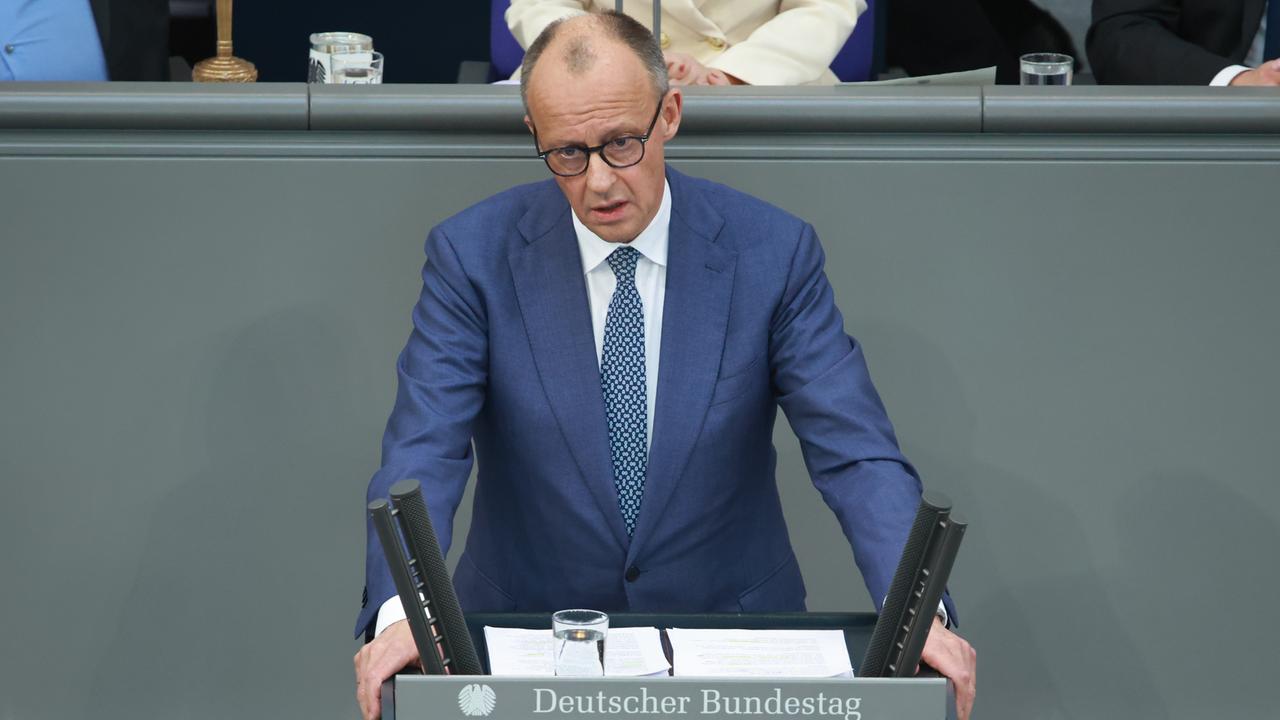
Friedrich Merz im ZDF: Union's Strategy for Upcoming State Elections Under Scrutiny
In a pivotal moment for German politics, Friedrich Merz, the leader of the Christian Democratic Union (CDU), recently sat down for the traditional ZDF-Sommerinterview. This high-profile appearance, broadcast just two weeks after the crucial European elections and a mere ten weeks before critical state elections in Saxony and Thuringia, offered a significant platform for Merz to articulate the Union's strategic direction. The interview, conducted by Diana Zimmermann in Merz's home region of Sauerland, was not merely a routine political discussion but a crucial opportunity to signal the CDU's intentions, clarify its stances on contentious issues, and rally support ahead of what promise to be fiercely contested elections in the eastern German federal states. The insights gleaned from Friedrich Merz's ZDF appearance are vital for understanding the future trajectory of the CDU and its potential impact on Germany's political landscape.
Decoding Friedrich Merz's Stance on Eastern State Elections
The upcoming state elections in Saxony and Thuringia are fraught with challenges and opportunities for the CDU. These regions have become hotbeds of political discontent, with right-wing populist parties gaining significant traction. During his Merz on AfD, BSW & East Elections: Key Insights from ZDF Interview appearance, Friedrich Merz was pressed to clarify the Union's "Brandmauer," or firewall, against the Alternative for Germany (AfD) – a topic that has repeatedly tested the CDU's resolve. The CDU's traditional role as a broad-based, conservative party is being challenged by the AfD's appeal to protest voters, particularly in the East.
Merz’s responses in the friedrich merz zdf interview are critical because they aim to reassure traditional CDU voters while simultaneously attempting to win back those who might have drifted towards more radical alternatives. The concept of a "Brandmauer" implies an absolute refusal to cooperate or form coalitions with the AfD, a position that some within the CDU have found difficult to maintain at the local level. Merz reiterated the party's official line, emphasizing that democratic parties must not legitimize or empower the AfD through collaboration.
Beyond the AfD, the emergence of the Bündnis Sahra Wagenknecht (BSW) presents another complex variable. The BSW, a new left-leaning populist party, has shown surprisingly strong results in recent polls, particularly in the East. Merz was questioned on the Union's approach to potential coalitions with BSW in the eastern federal states. Unlike the hardline stance against the AfD, the CDU's position on BSW appears more nuanced, albeit cautious. While ideological differences are significant, the BSW does not carry the same historical baggage or extremist accusations as the AfD, potentially opening a very narrow window for pragmatic, issue-based cooperation in exceptional circumstances, though Merz likely emphasized the challenges. The CDU aims to position itself as the stable, centrist alternative, capable of governing responsibly and effectively countering the fragmentation of the political landscape.
Navigating Coalition Dynamics: AfD and BSW Challenges
The political landscape in Germany, especially in the East, is becoming increasingly complex. The rise of the AfD and now the BSW has made the formation of stable governing coalitions a daunting task. For the CDU, this poses a significant strategic dilemma. If mainstream parties continue to lose ground, the arithmetic for forming majorities without either the AfD or BSW becomes incredibly difficult, potentially leading to minority governments or repeat elections.
In his friedrich merz zdf interview, Merz undoubtedly elaborated on the complexities. For instance, forming a coalition with the AfD is politically untenable for the CDU due to fundamental ideological differences on issues like European integration, immigration, and democratic values. The AfD's often radical rhetoric and association with right-wing extremism make any formal cooperation impossible for a party that prides itself on democratic principles and a commitment to the liberal democratic order.
The BSW, while different, also presents hurdles. Its economic and social policies, particularly its stance on NATO, the EU, and immigration, are often diametrically opposed to the CDU's conservative-liberal platform. For example:
- Economic Policy: BSW advocates for more state intervention and protectionist measures, clashing with the CDU's market-oriented approach.
- Foreign Policy: BSW's critical stance on arms deliveries to Ukraine and its more conciliatory approach towards Russia stand in stark contrast to the CDU's firm pro-NATO and pro-Ukraine position.
- Immigration: While less extreme than the AfD, BSW also champions stricter immigration policies, which might find some common ground with a segment of CDU voters but diverge from the party's broader integration efforts.
These fundamental policy disagreements mean that any cooperation, even informal, would require significant concessions from either side, making stable governance difficult. Merz’s statements in the ZDF interview aimed to delineate these boundaries, assuring voters that the CDU remains committed to its core principles while acknowledging the challenging political arithmetic. The Union's goal is to emerge as the strongest party, enabling it to dictate coalition terms rather than be forced into uncomfortable alliances.
Merz's Vision: An Alternative to the Ampel Coalition and Kanzlerkandidat Question
A significant portion of Friedrich Merz's ZDF appearance was dedicated to critiquing the current "Ampelkoalition" (traffic light coalition) of SPD, Greens, and FDP. Merz has been a vocal critic of the government's performance on several fronts, and the ZDF Sommerinterview: Merz's Kanzlerkandidat-Frage and Ampel Critique provided a prime opportunity to highlight what he perceives as its shortcomings and to present the CDU as a credible alternative.
Key areas of critique likely included:
- Economic Policy: Merz often argues that the Ampel government's policies stifle economic growth, burden businesses with excessive regulations, and fail to adequately address inflation and energy costs. He would have emphasized the CDU's commitment to fiscal discipline, reduced bureaucracy, and a stronger market economy.
- Energy Transition: While supporting the shift to renewable energy, Merz often criticizes the speed and methods of the Ampel's energy transition, particularly concerns about energy security and affordability for households and industry.
- Social Policy: Questions around social welfare reforms and immigration policies would have also been points of contention, with Merz advocating for policies that encourage work and reduce perceived burdens on the social system.
- Foreign Policy & Defense: The discussion about arms deliveries to Ukraine, mentioned in the reference context, is particularly sensitive. Merz has consistently pushed for stronger support for Ukraine, often criticizing the government for perceived hesitations or delays. He would have stressed the CDU's unwavering commitment to NATO and a robust defense policy.
Beyond policy, the interview also inevitably touched upon the perennial "Kanzlerkandidat" (chancellor candidate) question. Is there still an alternative to Merz leading the Union into the next federal election? While Merz has solidified his position as party leader, the question of who will ultimately challenge Olaf Scholz for the chancellorship remains a topic of internal debate and media speculation. Merz's confident performance in the friedrich merz zdf interview aimed to project an image of a decisive leader, capable of unifying the party and leading it to victory. He would have presented himself as the natural and most experienced choice, focusing on his economic expertise and his vision for Germany's future.
Strategic Implications and Future Outlook for the CDU
The ZDF-Sommerinterview is more than just a media appearance; it's a strategic platform to shape public perception and set the agenda. For Friedrich Merz and the CDU, this interview was crucial for several reasons. Firstly, by clearly stating the party's position on the AfD and outlining its cautious approach to BSW, Merz aimed to project an image of stability and democratic integrity, essential for winning over wavering voters.
Secondly, the critique of the Ampel coalition provided a contrast, allowing the CDU to present itself as a competent, experienced alternative ready to take the reins. Merz's focus on economic stability, security, and responsible governance is a deliberate attempt to appeal to a broad spectrum of voters disillusioned with the current government's performance.
The location of the interview in Merz's Sauerland home also held symbolic significance. It allowed Merz to present himself not just as a seasoned politician, but as a man rooted in his local community, connecting him to traditional values and a sense of Heimat (homeland) that resonates with conservative voters. This personal touch, coupled with his policy statements, aimed to bolster his public image and leadership credentials.
Practical Tips for Understanding German Politics Post-Merz ZDF Interview:
- Watch the East: The state elections in Saxony and Thuringia are litmus tests for Germany's political future. Their outcomes will heavily influence national debates and coalition possibilities.
- Observe the "Brandmauer": Any softening or pressure on the CDU's firewall against the AfD will be a major story, indicating shifting political norms.
- Follow BSW's Trajectory: The new party's performance is crucial. If it consolidates its support, it could fundamentally alter coalition dynamics at both state and federal levels.
- Scrutinize Economic Indicators: The CDU under Merz places a strong emphasis on economic performance. Watch how economic data is used in political discourse and how the CDU proposes to address challenges.
The friedrich merz zdf interview serves as a significant marker in the ongoing political discourse, laying out the Union's strategy for navigating a complex electoral landscape and positioning itself as the leading force in German politics.
In conclusion, Friedrich Merz’s appearance on ZDF was a high-stakes strategic communication effort designed to fortify the CDU’s position ahead of pivotal state elections and to articulate a clear alternative to the current federal government. His statements on the AfD and BSW, coupled with his critique of the Ampel coalition and his implicit assertion of leadership, painted a comprehensive picture of the Union's immediate electoral strategy and its long-term vision. As Germany navigates a period of significant political realignment and societal challenges, the CDU, under Merz's leadership, seeks to project an image of stability, competence, and resolute conservative values, aiming to reclaim its dominant role in German politics and effectively govern the nation.